Acoustic metamaterials (popular-science)
Acoustic metamaterials are engineered structures whose geometry—not just their base material—controls how sound propagates. By designing subwavelength “unit cells” (e.g., resonators, membranes, labyrinthine channels, metasurfaces), we can create effective properties and boundary behaviors that are difficult or impossible to achieve with conventional materials.
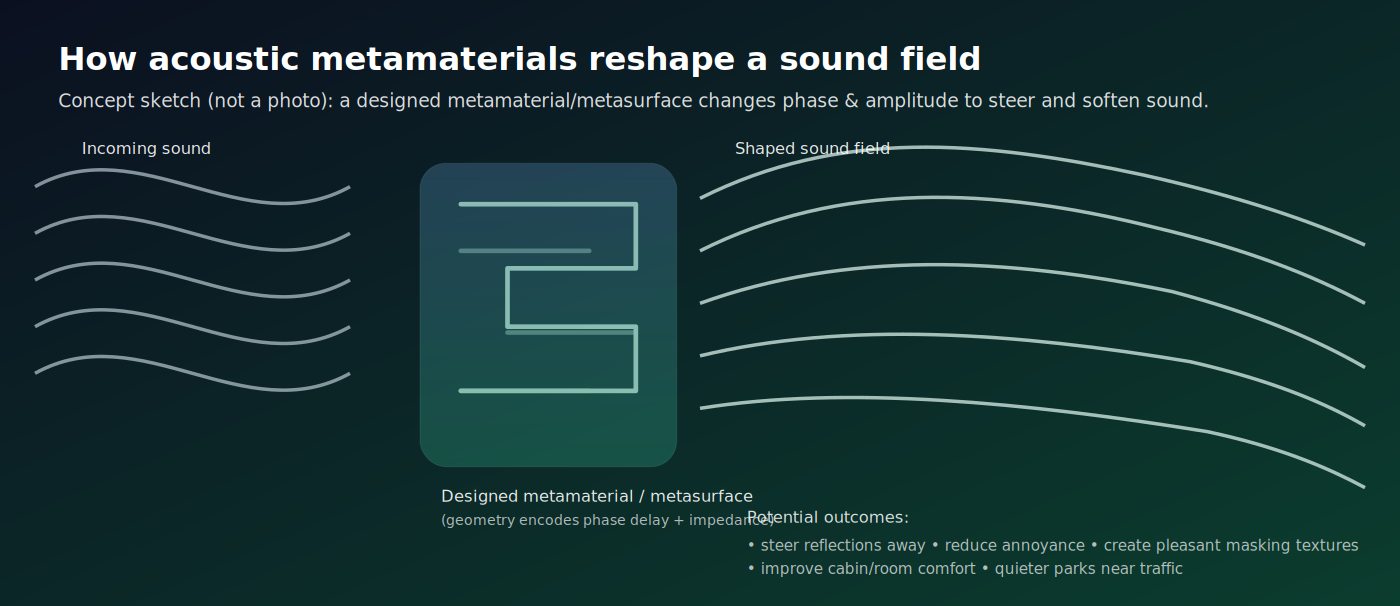
What can they do?
Typical capabilities relevant to SMILE include:
- Low-frequency control with lightweight designs (e.g., local resonance instead of mass)
- Wavefront shaping: steering, focusing/defocusing, and reducing problematic reflections
- Broadband sound management via combinations of resonant + non-resonant mechanisms
- Reconfigurable or adaptive behavior (actively tuned structures)
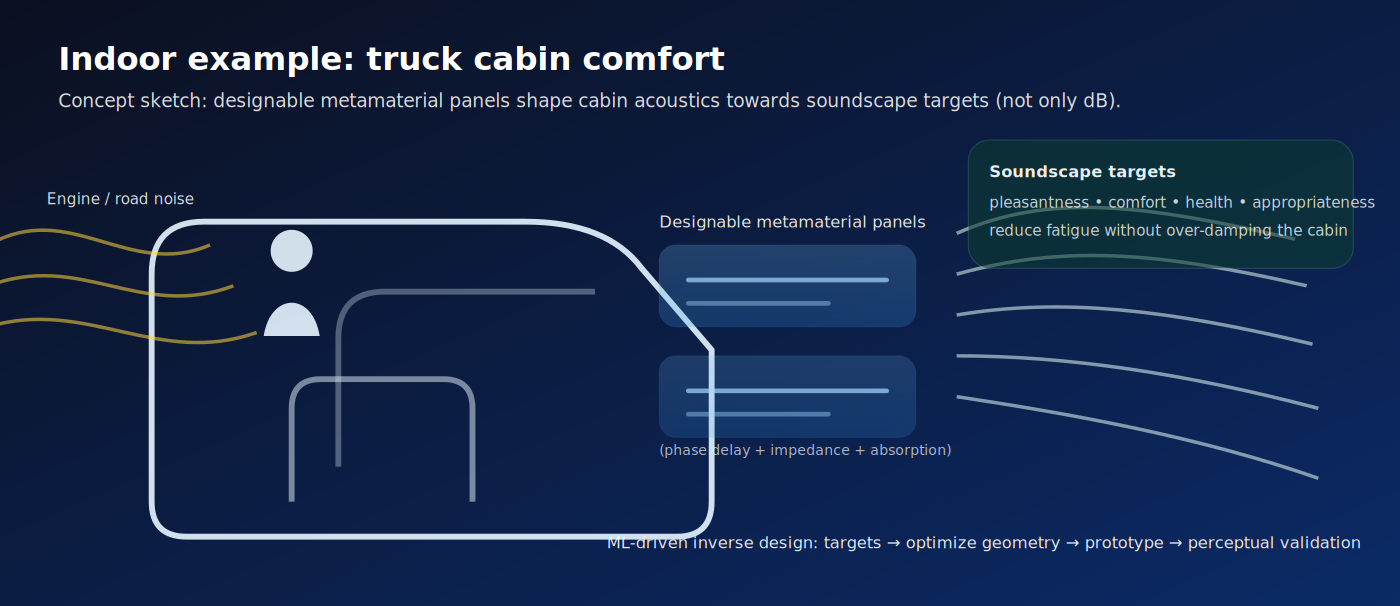
In SMILE, we treat metamaterials as a designable “acoustic interface” that can be optimized to meet soundscape targets (comfort, pleasantness, context-appropriateness), rather than only minimizing dB.
Why metamaterials matter for soundscapes
Traditional noise control is often framed as: “reduce sound level.” Soundscape engineering is different: it asks how a place should sound for people.
Metamaterials expand the design space by letting us shape:
- spectral content (which frequencies are reduced or transformed)
- temporal character (impulsiveness, roughness, modulation)
- spatial perception (directionality, reflections, acoustic “scene”)
This is crucial for both:
- Indoor contexts (e.g., cabins/rooms): reduce fatigue and improve comfort.
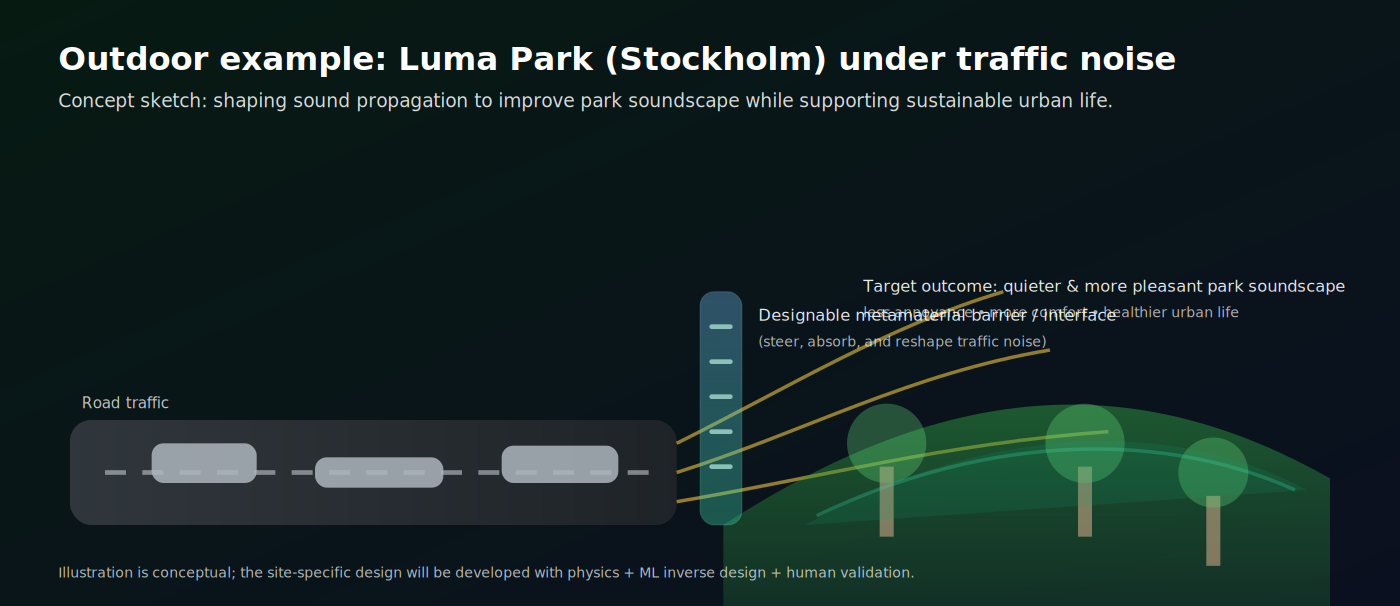
- Outdoor contexts (e.g., parks near traffic): create healthier, more pleasant urban environments.
Indoor & outdoor examples (concept sketches)
Indoor: truck cabin
Outdoor: Luma Park (Stockholm)
Inverse design (ML) + physics
Because metamaterial behavior depends on complex geometry, we typically cannot “hand-design” the best solution. SMILE therefore combines:
- High-fidelity simulation & physical modeling (wave propagation + structure–acoustics)
- Machine-learning-driven inverse design (optimization / generative search)
- Perceptual validation (VR soundscape evaluation + human feedback)
Selected references (with links)
-
Cummer, S. A., Christensen, J., & Alù, A. (2016). Controlling sound with acoustic metamaterials. Nature Reviews Materials, 1, 16001.
Links: DOI • Author PDF -
Review (open access via PubMed Central): Underwater acoustic metamaterials. (Review article).
Link: PMC article -
Example of reconfigurable labyrinthine (space-coiling) metamaterial (Nature Portfolio page): A magnetically actuated dynamic labyrinthine transmissive ultrasonic metamaterial.
Link: Nature page
Image & attribution
- The figures on this page are concept sketches created for the SMILE website. They are not copied from papers.